
Introduction
Purpose and Scope
The purpose of this document is to provide a comprehensive cloud reference architecture that serves as a blueprint for designing, implementing, and managing cloud solutions. This architecture is designed to be industry-agnostic and aligns with established frameworks such as the Microsoft Cloud Adoption Framework, NIST SP 500-291, and ISO/IEC 17788. It addresses key aspects such as scalability, security, governance, and operational excellence.
Document Control
| Item | Value |
|---|---|
| Document Title | <Solution / Platform Name> – Azure Reference Architecture |
| Version | 0.1 (Draft) |
| Date | <YYYY-MM-DD> |
| Author(s) | <Name(s)> |
| Reviewer(s) | <Name(s)> |
| Approved by | <Name / Role> |
Scope
In Scope
- Azure Landing Zone(s) and subscriptions
- Network topology (Hub-Spoke,vWan)
- Core Services (Compute, Storage, Identity, Networking, Monitoring)
- Connectivity to On-Premise / Other Clouds
- Enrollment Management
- DevOps Organization Management
Out of scope
- Application code-level design
- Business Workflow details
Examples
Scalability: Leveraging auto-scaling groups to handle variable workloads, as recommended in the Microsoft Cloud Adoption Framework.
Security: Implementing identity and access management (IAM) policies in alignment with NIST guidelines.
Governance: Establishing resource tagging and cost management practices inspired by the AWS Well-Architected Framework.
Target Audience
This document is intended for a diverse audience involved in cloud adoption and management, including:
Cloud Architects: To design scalable and secure cloud solutions.
Cloud Engineers: To implement and maintain cloud infrastructure.
Decision-Makers: To understand the strategic value of cloud adoption.
Developers: To build applications optimized for cloud environments.
Audience Examples
A cloud architect designing a multi-region deployment strategy.
A cloud engineer implementing CI/CD pipelines for automated deployments.
Decision-makers evaluating the cost-benefit analysis of cloud migration.
Document Structure
This document is organized into the following sections:
Introduction: Overview of the document's purpose, audience, and structure.
Governance: Best practices for managing cloud resources, including policies and compliance.
Security: Strategies for securing cloud environments, including IAM, encryption, and network security.
Scalability and Performance: Techniques for ensuring applications can handle varying workloads efficiently.
Operations and Reliability: Approaches for maintaining high availability and disaster recovery.
Case Studies and Use Cases: Real-world examples of cloud adoption.
High-Level Cloud Architecture
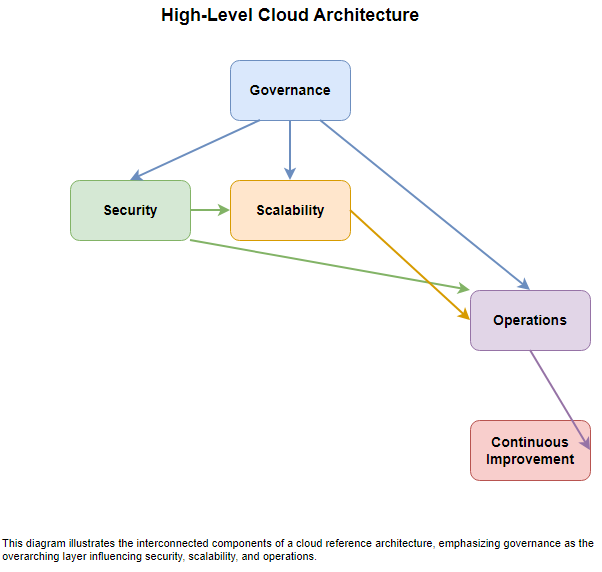
This diagram illustrates the interconnected components of a cloud reference architecture, emphasizing governance as the overarching layer influencing security, scalability, and operations.
Cloud Adoption Phases
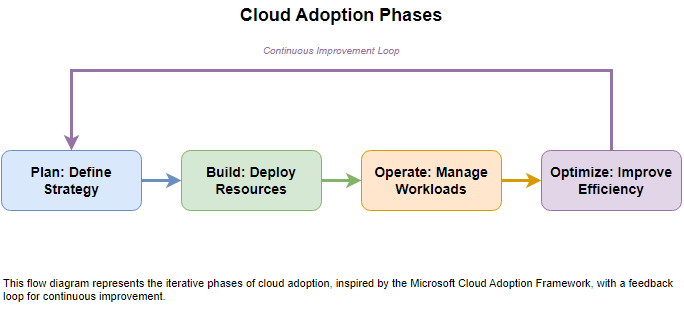
This flow diagram represents the iterative phases of cloud adoption, inspired by the Microsoft Cloud Adoption Framework, with a feedback loop for continuous improvement.